
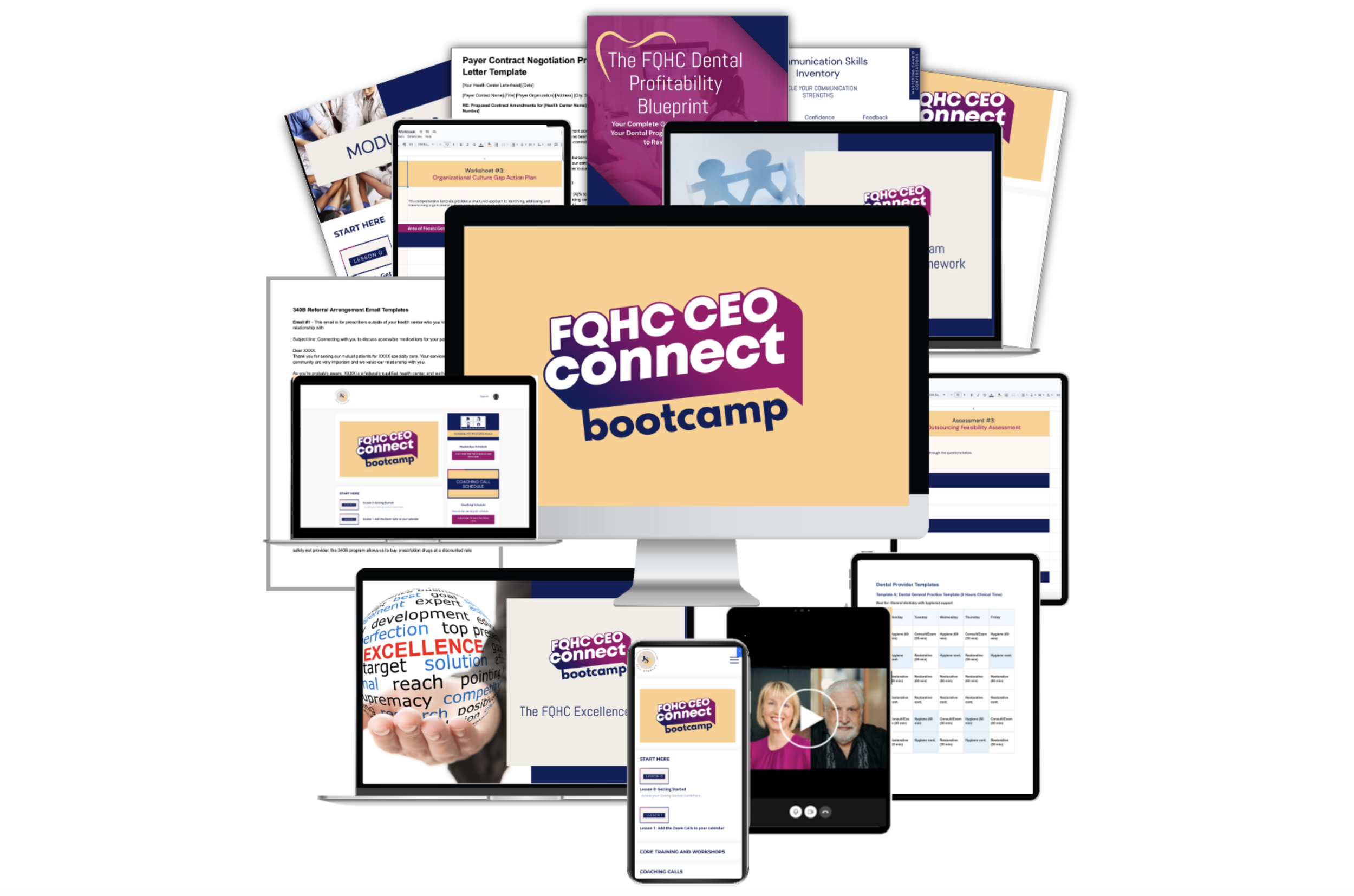
Jill and I didn’t start with the idea of building a Bootcamp. It came out of a pattern we kept seeing across health centers in different markets, with different leadership teams, facing what were often very similar challenges.
In most cases, the issue wasn’t a lack of effort or commitment. It was that the role itself requires leaders to operate inside a system that doesn’t consistently support long-term stability. Over time, that creates pressure that isn’t always visible from the outside—but is very real for the people responsible for keeping the organization moving.
If you’ve been in that seat, you’ve likely felt some version of it.
Listen to the Podcast Episode About This Topic 🎧
Why We Built the CEO Connect Bootcamp (And What Health Center Leaders Are Saying About It)
In this episode of Community Health Collective, Jill Steeley shares the backstory behind why the Bootcamp was created, how it was designed, and what health center leaders are experiencing inside the program. The conversation also includes real examples and direct feedback from participants.
The Structural Reality Most Leaders Are Navigating
There is a tendency in this space to frame challenges primarily in terms of external forces—funding levels, policy changes, workforce shortages. All of those matter.
But they don’t fully explain why some health centers stabilize and others remain in a constant cycle of reacting.
As discussed in the podcast, most health centers are operating within a model that was designed to support access, not necessarily to ensure financial sustainability. That distinction is subtle, but important. It means that many of the pressures leaders experience are not temporary—they are built into the structure itself.
When that structure is taken at face value, organizations often default to managing symptoms rather than addressing underlying constraints.
A Framing That Tends to Shift the Conversation
Jill has a line she uses that captures this well:
“Profit is not greed. It is oxygen.”
That’s not a philosophical position. It’s a practical one.
Without margin, there is very little flexibility in how an organization operates. Decisions become reactive, timelines compress, and the ability to invest in long-term improvements narrows. Over time, that affects everything from staffing to patient access to strategic planning.
The challenge isn’t whether a health center should prioritize its mission. It’s whether the organization is structured in a way that allows that mission to be sustained.
Where This Perspective Comes From
Jill’s perspective is grounded in her experience leading a health center that was close to shutting down. When she stepped into the CEO role, the organization was facing a nearly $1 million deficit, declining patient numbers, and a board that was prepared to close the doors if things didn’t change within a year.
At the time, there wasn’t a clear framework for how to approach that situation. There wasn’t a built-in peer network to compare strategies with, and there wasn’t a structured way to prioritize what would actually move the needle.
She had to work through that in real time.
My background has been more on the systems side—working inside health centers and with leadership teams to understand why certain approaches lead to stability and others don’t. Over time, the same patterns tend to show up.
Different organizations. Similar underlying dynamics.
The Four Areas That Consistently Drive Results
Across those experiences, most of what impacts financial stability comes back to four interconnected areas:
Revenue, including payer mix and how services are structured
Costs, particularly how they align with operational realities
Market presence, or whether the community and employers understand what the health center offers
Patient experience, which ultimately determines retention and continuity of care
Most organizations are working on one or two of these at any given time. Fewer are approaching them in a coordinated way. When one area is out of alignment, it tends to create pressure in the others.
This is where a lot of the day-to-day challenges originate.
How This Shows Up in Practice
The specific situations vary, but the underlying patterns are consistent.
In one case discussed in the episode, a CEO focused on revenue quality rather than just volume and identified opportunities in payer contracts, pharmacy, and employer relationships that had been overlooked. In another, an operations leader addressed staff and patient turnover and saw both financial and operational improvements as a result. In another, a health center with strong clinical care but limited visibility in its market shifted how it engaged employers and saw a meaningful change in its position locally.
These are different starting points, but they reflect the same principle: when the underlying structure changes, the outcomes tend to follow.
What Leaders Tend to Highlight Afterward
One of the more useful parts of the episode is hearing directly from participants about what stood out to them.
Some point to the practical tools and templates, particularly the ability to move from ideas to implementation without having to build everything from scratch.
Others highlight the value of hearing how peers are approaching similar challenges in their own organizations.
But one theme comes up consistently: the ability to have open, candid conversations with people who understand the role.
“You’re able to let your hair down and really be open about the problems you're dealing with…”
“It’s helpful to hear that you are not just dying on the vine alone.”
That’s not always easy to find in this space, and it tends to matter more than people expect.
A Practical Way to Think About ROI
There’s a point in the episode where Jill talks about how leaders often evaluate whether something is “worth it.” The conversation usually focuses on cost, which is understandable given the constraints most organizations are operating under.
A more useful way to think about it is in terms of impact.
If a single change meaningfully improves revenue, retention, or staffing stability, that tends to have a disproportionate effect on the organization as a whole. Most health centers don’t need every part of the system to change at once. They need the right parts to change in a way that compounds over time.
That’s where the difference tends to show up.
What We’ve Seen Across Cohorts
Across the groups we’ve worked with, there have been consistent improvements in revenue, cost structure, and patient retention.
Those outcomes matter, but they’re not the only takeaway. In many cases, the more significant shift is how leadership teams are approaching decisions—moving from reactive problem-solving to a more structured way of evaluating where to focus and why.
That shift tends to carry forward beyond any single initiative.
Why This Episode Is Worth Listening To
This episode is less about a program and more about how to think about the role itself.
It reflects Jill’s experience, the patterns we’ve seen across organizations, and the perspectives of leaders who have had the opportunity to step back and evaluate their approach in a more structured way.
If you’re working through similar challenges—or seeing the same issues repeat—it’s a useful conversation to spend some time with.
Listen to the Podcast Episode About This Topic 🎧
Why We Built the CEO Connect Bootcamp (And What Health Center Leaders Are Saying About It)
In this episode, Jill walks through the full backstory behind the Bootcamp, shares real examples from health centers, and includes direct feedback from leaders on what actually changed for them.
Continuing the Conversation for Health Center Leaders
Jill and I have been continuing this discussion in a series of sessions with health center leaders, focused on how these ideas translate into day-to-day operations.
Each session looks at where organizations tend to get stuck, what tends to move the needle, and how to prioritize efforts in a way that leads to more stable outcomes over time.
If you’d like to go deeper into that, you’re welcome to join us. You can register for one of our two final sessions here.
